
01
The loudest voice wins
Almost nobody points to a documented, peer-reviewed lifecycle map as what’s setting strategy.
 customer.ioResearch report
Original research from Customer.io
We asked lifecycle marketers to share their unfiltered thoughts on their email programs. Here’s how they’re feeling about strategy, churn, automation, and AI.
How’d we get here?
We ran two versions of the same set of questions.
First, an online pulse check, sent to marketers ahead of Drive by Exit Five, a marketing conference in Stowe, Vermont.
Second, a live, in-person version of the same questions, run as a workshop at Drive itself. Around 50 marketers walked into a room, and instead of filling out a form, they placed a physical sticker on a spectrum for each of nine questions, a poster with two opposite answers on either end and a line between them. The session closed with a fireside chat with Luke Reynebeau, VP of Product Marketing at Bitly, and small-group roundtable discussions on three open questions.
This report covers both. The short version of what we found: marketers trust email as a channel, but most haven't proven their own program needs it, and that gap shows up everywhere: in how teams track churn, how they measure reporting, and who ends up owning the decisions.

The reality check / Key findings
Almost nobody points to a documented, peer-reviewed lifecycle map as what’s setting strategy.
Lifecycle tends to stay a solo job longer than other marketing roles before a company invests in a real team.
Bitly’s best email asked one honest question with no CTA, and it pulled 2.5× their normal reply rate.
Nobody trusts AI to personalize live or at scale without a person checking it first.
72% run a mix of manual and automated campaigns. Only 3% said fully automated.
Only 17% said stopping email would cause a serious hit. Most landed between “barely a dent” and “not sure.”
The audit
Each signal includes the prompt as it appeared in the room, what the room said live, what 210 marketers said before the workshop, and a tactical fix to try this week.
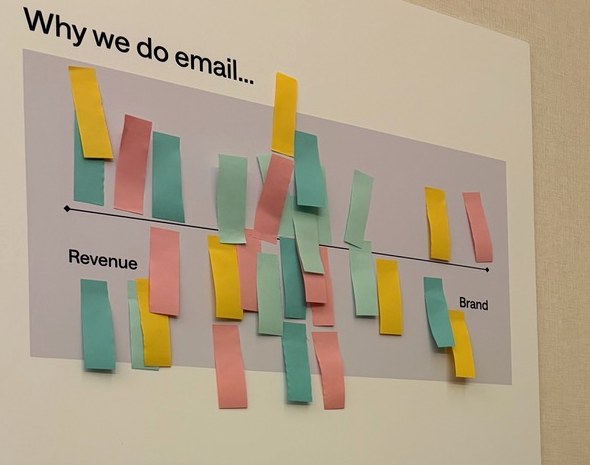
Revenue and brand are tied in this room. Nobody's settled which one email is for.
58% of respondents named email as the channel that drives their best ROI, more than SMS, in-app, and push combined.
The room's even split probably isn't indecision so much as different marketers each having a clear, different answer. E-commerce and PLG teams lean revenue; brand-led or content-heavy teams lean brand. Some marketers reject the premise entirely because a single email can do both jobs at once.
Treat email as a conversion channel first. It builds awareness along the way, but that's a side effect, not the job it's there to do. If your team gets evaluated on brand lift, but the emails you're sending are automated, revenue-driving campaigns, you're measuring the wrong thing.
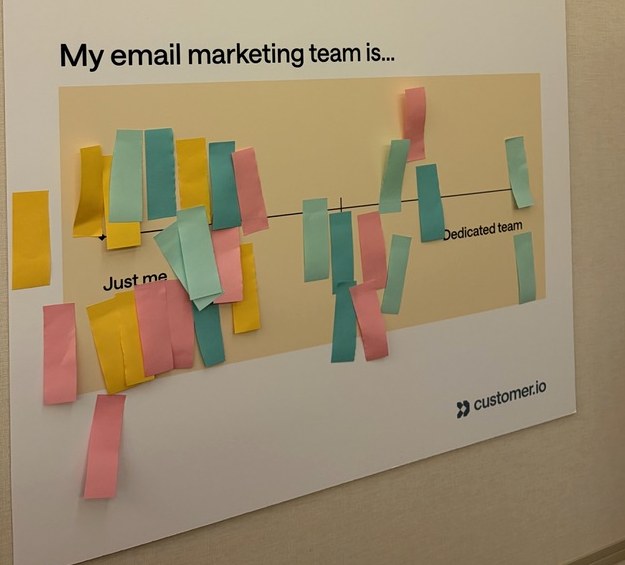
Most people in the room are either working solo or running a full team, without much of a middle ground.
Team size shapes what's possible more than it determines what's smart: solo marketers tend to move faster and experiment more; bigger teams are better positioned to scale what's already working.
Lifecycle tends to stay a one-person function longer than other marketing roles. Companies often jump from solo to a proper pod once headcount gets approved rather than growing gradually.
At Customer.io, we don't have a single "email team." Growth marketers use email to drive product adoption, product marketing uses it to launch features, demand gen uses it to nurture and send content and resources, and the list keeps going.
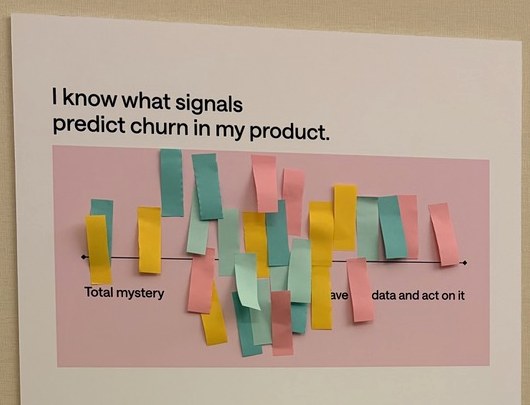
Most of the room knows there's a signal worth watching for churn, but isn't acting on it yet.
Only 26% track churn signals and act on them. 50% have "some idea, but no action on it." 25% called it a total mystery.
Three out of four marketers either can't name what predicts churn or can name it and still aren't doing anything about it. Churn signals live in product analytics tools that most marketers can already see, but acting on them requires lifecycle infrastructure, a trigger, a journey, that most teams haven't built.
There's an ownership layer underneath that too: the signal sits with whoever owns product data, while the response sits with marketing.
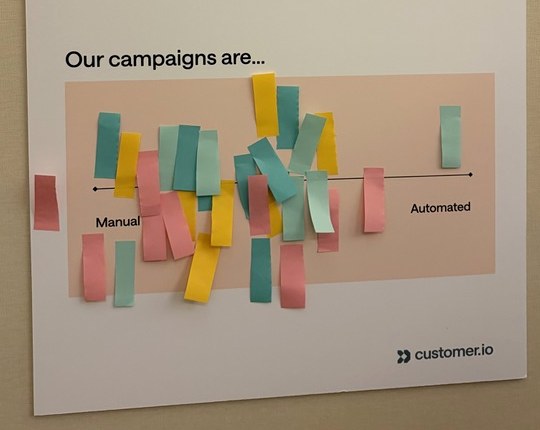
Manual still wins in this room. Full automation is rare, and the gap is wider than our pre-event survey.
72% run a mix of manual and automated campaigns. Only 3% are fully automated, and 25% are still mostly manual and one-off.
"Somewhere in between" is the norm, and "fully automated" stays rare even in a room full of people who focus on email for a living.
Automation isn't the goal. It's what buys you the time to do the parts of the job a workflow can't: strategy, judgment, the actual thinking.
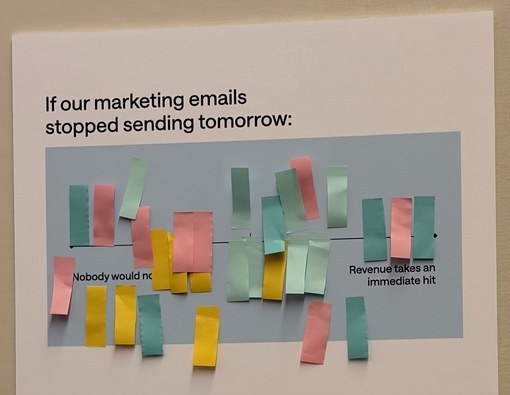
Most of the room thinks losing email would cause a dip, not a crisis.
35% said a noticeable dip, 27% said barely a dent, 21% weren't sure, and only 17% said a serious hit.
Fewer than one in five marketers are confident their email program is revenue-critical. We think this room is underrating its own impact.
Email rarely gets full credit in a standard attribution model because it influences a decision without closing the last click. Being unsure whether email is revenue-critical usually means the attribution is broken, not that the channel isn't working.
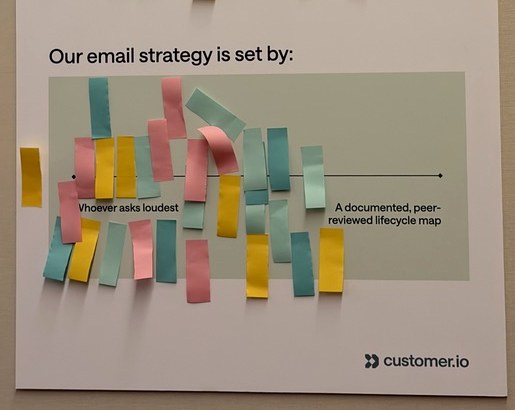
Strategy in this room is set by whoever pushes hardest, not by a documented plan.
59% said reporting and measuring success is a top challenge, and 57% said their systems and data are out of sync.
Whether you're the most junior person on the team or the one who signs off on budget, a documented strategy makes your job easier. It gives you something to point to instead of re-litigating priorities every time someone makes a loud ask, and gives whoever you report to a clear reason to trust your calls.
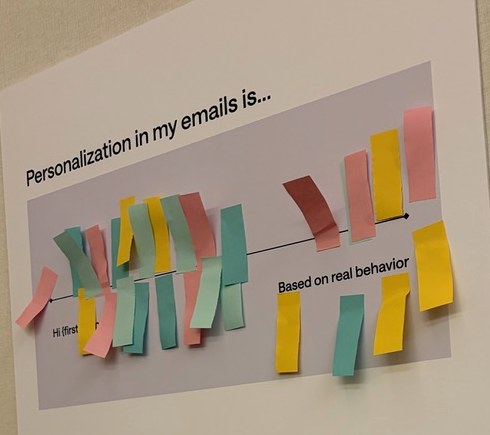
The room split. Several people pushed back on personalization as the goal at all: what they wanted was relevance, the right message at the right moment.
When asked what they'd fix with a magic AI wand, marketers put automation and data integration ahead of personalization.
People want messages that feel earned because they're tied to something real: a job title, product usage, past content, behavior. One marketing leader at a B2C freemium company said an AI-driven personalization step they tried "didn't get close enough" without more first-party data.
Relevance is the right goal. Personalization is the mechanism teams reach for first because it's easier to build than real relevance is.
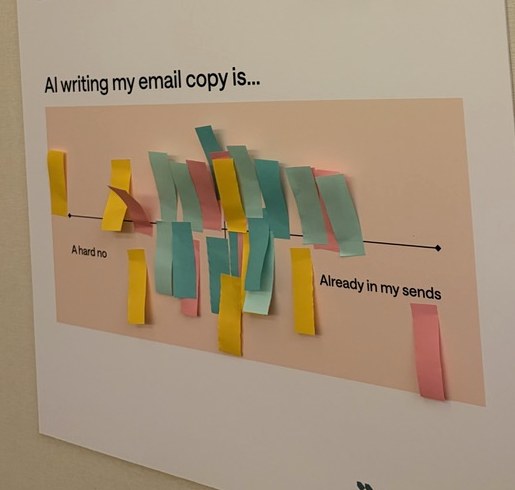
This room uses AI everywhere in their workflow, but they're not handing it the publishing and sending role.
84% are cautiously optimistic or excited about using AI in their email program. Only 6% are skeptical. Average self-rated adoption: 6.7 out of 10.
High AI adoption and staying hands-on aren't in conflict. AI can draft, suggest, and save time, but the sentence a customer reads still gets a person's judgment before it ships. This is still a human craft.
The bigger opportunity sits upstream: surfacing the moment a customer is ready to hear from you, finding the relevance that makes a message worth sending, and organizing scattered research into something usable.
A quadrant exercise: Marketing versus Product on one axis, Customer Success versus Sales on the other.
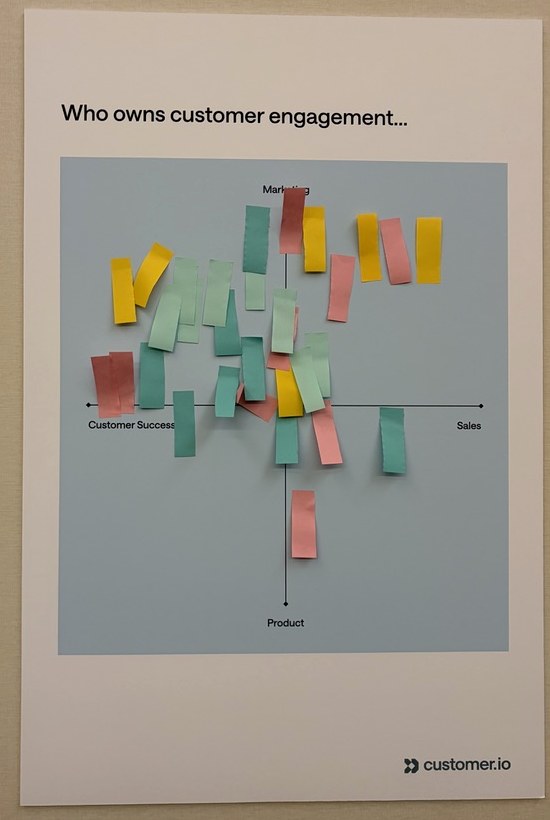
Marketing owns customer engagement among this group, with close collaboration with CS, Sales, and Product teams.
We didn't ask this one directly. It shows up sideways in the churn data: only 26% of the 210 marketers track churn signals and act on them, and the signal that should trigger a message usually lives with whoever owns product data, while the send itself lives with marketing.
Owning engagement doesn't mean marketing works alone. The programs that work best are the ones where marketing sets the strategy and pulls in the right team at the right moment: Product for usage signals, Customer Success for what's frustrating people, Sales for what made a deal close or stall.
Ownership is about who's accountable for the outcome, not about doing all the work alone. Owning engagement means owning that handoff.
Roundtable
At the live workshop, roundtable groups worked through three open questions.
More than one table landed on the same line, which got a real laugh from the room: not all emails are worth sending, and a tighter series beats a bigger blast every time. Being behind on email is usually a buy-in problem, not a tactics problem, one table described a broader team that still wants to spray and pray even after seeing solid data telling them not to. Sender identity matters more than most programs treat it: one table watched open rates drop after switching domains without enough care, and another said sending from a real person consistently outperforms a reply-all or no-reply address. Data hygiene came up unprompted at multiple tables as the actual reason automation and AI work underperforms, not the tools themselves.
AI-generated content that reads as generic doesn't perform, and it's starting to trigger real backlash, several tables mentioned AI detectors people are now running on their own inboxes. The fix the room landed on wasn't a better prompt. It was reading more, real books, real writing, to keep a voice that still sounds human. The strongest cross-table agreement of the whole session: relevance beats personalization. A message timed to something a person did outperforms a first-name token, and the reason is subtlety, not cleverness. Nobody at any table said they'd trust AI to personalize messages live or at scale without a person checking it first.
The most honest answer in the room, also the one that got a laugh: "nothing." One table said it's been a genuinely hard year for email, AI included, and they're still looking for where the value is supposed to show up. Consistency did the opposite job for another table: committing to a steady cadence, one monthly send and one biweekly send, beat a constant stream of one-offs and was the single biggest shift in their program this year. Short, low-effort follow-ups outperformed long recaps for more than one table. A simple "want the recording?" got far more replies than a full webinar summary ever did.
The synthesis
Two data sources, gathered two different ways, tell a consistent story: marketers trust email as a category, but most haven't proven their own program needs it.
Here's the gap: 58% of the 210 marketers surveyed said email drives their best ROI, more than every other channel combined, but when asked what happens if they paused sending for a month, only 17% said "a serious hit," and the rest landed somewhere between "a noticeable dip," "barely a dent," and "not sure." Belief in the channel is strong. Proof for the specific program is thin.
Two patterns explain why. Automation makes churn visible, not only faster to act on. Marketers running mostly manual campaigns are more than twice as likely to call churn signals "a total mystery" (43%) as marketers running a mix of manual and automated work (19%), and the share who track a signal and act on it nearly doubles once automation enters the picture (17% to 29%). Automation's value goes beyond saving time: it turns a signal sitting in a dashboard into a message that fires.
But automation trades one kind of pain for another. Teams furthest along on automation report the least manual-process pain of any group, yet the most reporting pain and budget pain, since as execution gets easier, proving that execution mattered only gets harder. The hard question shifts from "can we send this" to "can we defend the budget for it."
Reporting is the one pain point that shows up everywhere, regardless of company size, business model, or how automated the program already is, and marketers aren't betting a new platform will fix it: how likely someone is to overhaul their tech stack barely shifts whether or not they're struggling with reporting today. People know measurement is broken. Most aren't convinced a new tool solves it.
Marketers trust email. What most programs haven't built yet is the muscle to prove it's working, tie it to churn before someone leaves, or agree internally on what it's for. That gap, not the channel, is what's dying. The live room confirmed this pattern more than it broke from it: the same distrust of AI at scale, the same instinct toward relevance over personalization, and the same honesty about data being the real bottleneck showed up in the roundtable conversations that showed up in the survey of 210 marketers who'd never met the group in the room.
Customer spotlight / Bitly

Luke Reynebeau, VP of Product Marketing at Bitly, joined the workshop for a fireside chat. Bitly started as a URL shortener and has expanded well beyond that, and its lifecycle and customer marketing functions now sit inside a broader product marketing org, led day to day by lifecycle marketers Devin O'Toole and Joanne Baldwin. The whole conversation ran on one piece of framing from Luke: every email is a brand moment, not only a conversion attempt, whether it's driving revenue or not.
Bitly has moved away from "Hi {first_name}" personalization toward what Luke described as reflecting real data back at someone, closer to a Spotify Wrapped moment than a mail-merge variable. Segmentation does more work for them than personalized copy does. They're consolidating their programs onto a single platform across both of their products specifically to make that kind of reflection possible at scale.
Devin's team sent an email to their most engaged free users with no call to action, no link back to the product, and no mention of Bitly at all. The entire ask was a single open question: name one thing you'd like advice on. They reserved it for the already-engaged segment first, defined by recent email opens and product activity, and Devin replies personally to real questions that come back, a practice the team maintains across the program, not only for this one send. The email got 2.5 times Bitly's typical reply rate and a 50% open rate, against a normal range of 35 to 45% for free-tier sends. Close to half the replies turned into informal product feedback that got routed straight back to product, and it became a repeatable format, an "advice inbox" follow-up, instead of a one-off experiment.
Luke was direct that lifecycle strategy is a balance, responding to what the business needs on one side, pushing back with data on the other, not something set in a vacuum. Bitly's lifecycle team brings quantitative understanding of their customers into product and launch conversations, which is what gets them included in planning a launch instead of finding out about it the week it ships.
Free users get one email a week, gated by relevance, people who stop engaging fall off the list rather than getting emailed into oblivion. Onboarding sequences run at a higher velocity, up to daily, but stop the moment a customer hits the milestone they're aimed at. Paid customers get touched less often, biweekly to monthly, with heavy suppression logic so nobody gets a generic broadcast and a triggered send in the same week.
Bitly ran a version of the same "no ask" idea around the Super Bowl: an email that simply acknowledged their customers don't have a Super Bowl-sized marketing budget either, no product mention, no CTA, only a human moment. It pulled a wave of goodwill replies. Pick one moment a customer base is already feeling (a season, a shared frustration, a shared constraint) and send something that names it without asking for anything back.
Bitly's results are the clearest real-world proof of the personalization finding elsewhere in this report. Their highest-performing email had the fewest personalization tricks, no first name, no product pitch, no offer, and it worked because it was the most relevant thing that specific audience could receive at that moment.
Scorecard
Not a recap. For each question: the pattern, why it happens, and one fix worth trying this week.
| Question | The pattern | Why it happens | Fix this week |
|---|---|---|---|
| 01Revenue vs. brand | No consensus, the room was split | Different business models want different things from email | Split a month of sends by call to action, then measure revenue sends by conversion and revenue per send, and brand sends by opens and replies |
| 02Team size | Solo or fully staffed, almost no in-between | Lifecycle rarely gets headcount until it's already proven itself | Map who owns each recurring send this week, whatever the team size |
| 03Churn signals | Most know the signal, few act on it | The signal lives in product data; the response lives in marketing | Build one trigger this week: signal in, message out, no other conditions |
| 04Manual vs. automated | Manual still wins | Automation buys time, but building it costs time too | Automate the one campaign rebuilt by hand most often |
| 05Revenue impact if paused | Most expect a dip, not a crisis | Standard attribution rarely credits email's assist role | Pause the least-missed campaign for two full send cycles and measure the dip |
| 06Strategy ownership | Whoever asks loudest, overwhelmingly | Nobody's forced to write a strategy down until someone asks for it | Draft a one-paragraph strategy from real business goals and get it signed off |
| 07Personalization | Polarized: first names or real behavior, nothing between | Relevance takes data infrastructure most teams don't have yet | Swap one static line for a real behavioral trigger and ship the test |
| 08AI writing copy | Already in the workflow, not making the final call | Marketers want AI's speed on the busywork, not its judgment on the message | Ask AI to surface one segment showing a strong signal, then turn that into a one-page campaign brief before anyone writes copy |
| 09Engagement ownership | Marketing owns it, working with CS, Sales, and Product | Ownership means accountability, not solo execution | Set up a recurring 15-minute sync with whoever holds the data that's missing |